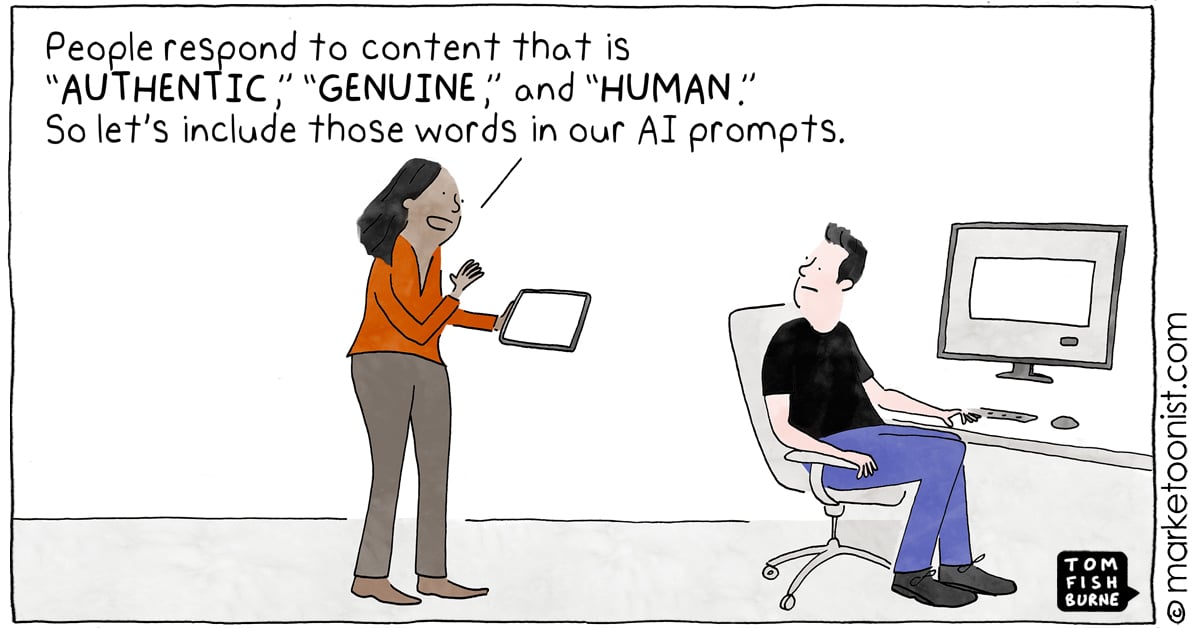
Banning em dashes cuts AI slop by 3%. A style guide written in 1986 for aircraft mechanics cuts it by 74%. Its authors had never heard of an LLM — they wrote it so a mechanic wouldn't misread a torque spec and get someone killed.
Why banning words doesn't work
The trigger was a viral back-and-forth (Joe Gristle, Vox, and the usual pile-on) about how to stop AI writing from sounding like AI. The standard advice is a blocklist: don't say "delve," don't use em dashes, don't say "it's not just X, it's Y." That's whack-a-mole, and the mechanism is worth stating plainly: the model isn't attached to "delve" as a word. It defaults to the statistical average of internet writing because nothing told it to do otherwise. Block one word and the average shifts one word over. You're not removing the failure mode, you're renaming it.
Slop is six specific habits, not a feeling
The more useful move is refusing to leave "AI slop" as a vague aesthetic complaint and instead naming six mechanical, checkable habits:
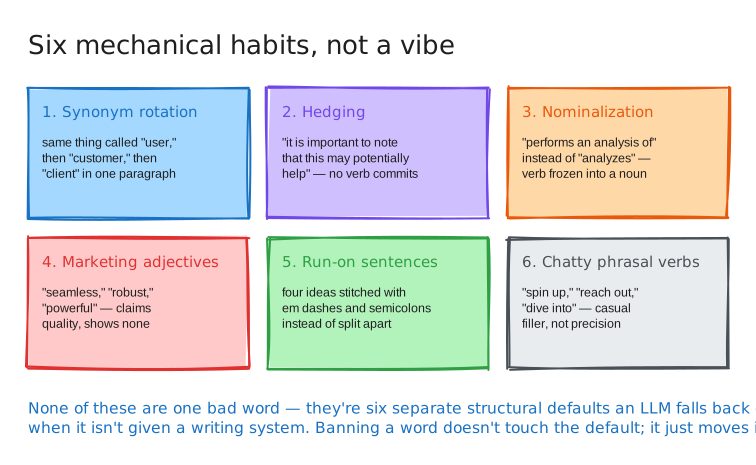 The six habits a blocklist can't touch, because none of them live in a single banned word.
Once slop is six named failure modes instead of one fuzzy feeling, "make it sound less like AI" stops being a matter of taste and turns into something you can actually check a paragraph against, line by line.
What ASD-STE100 actually is
The fix is Simplified Technical English, known by its standard number ASD-STE100. European aerospace manufacturers wrote it starting in 1986, for a specific, high-stakes reason: aircraft maintenance manuals get read by mechanics who don't all have English as a first language, and a misread instruction on a fuel line isn't a bad user experience, it's a fatality.
The standard has two parts. Part 1 is structural writing rules. Part 2 is a dictionary of roughly 900 approved words, and the constraint that makes it work is that every word gets exactly one meaning and one grammatical job. "Fall" only ever means physical downward movement under gravity, never "decrease." To start something, the manual allows exactly one verb, "start," and explicitly bans "begin," "commence," "initiate," and "originate" as competing synonyms for the same action.
That single-meaning-per-word constraint is the whole trick. Most style advice tells you what not to write. STE tells you which one word is always correct, so there's no ambiguity left to default into.
The same rulebook that stops a mechanic's mistake stops an LLM's
Here's the part that makes this more than a historical curiosity: each of the six slop habits maps to a named STE rule, one to one.
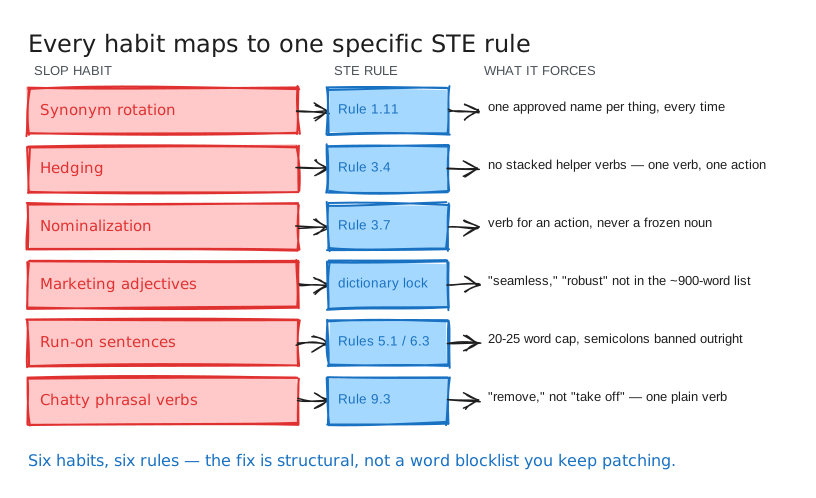 Not a coincidence — STE was written to eliminate ambiguity, and slop is just ambiguity with better PR.
Rule 1.11 (one name per thing) kills synonym rotation directly. Rule 3.4 bans stacked helper verbs, which is what hedging is made of. Rule 3.7 forces a verb to stay a verb instead of freezing into a noun phrase, which is nominalization. The dictionary itself locks out "seamless" and "robust" because they aren't on the approved list. Rules 5.1 and 6.3 cap sentences at 20-25 words and ban semicolons outright, which makes a run-on sentence structurally impossible to write. Rule 9.3 requires plain verbs over phrasal ones, so "remove the panel" replaces "take off the panel."
None of this was designed with LLMs in mind. It was designed so a mechanic in a second language wouldn't guess wrong about a torque spec. The fact that it happens to name and eliminate exactly the six habits that make AI writing feel hollow says something about what "clear" and "slop-free" actually mean: they're the same property, described by two different industries forty years apart.
Controlled English already has a track record
Before getting anywhere near an LLM, it's worth checking whether constrained technical language actually helps human readers, and the effect size is large enough to take seriously:
- A 1996 aerospace study (Shriver et al.) had aircraft technicians read STE-compliant manuals versus standard ones. Overall comprehension went from 76% to 86%. For non-native English speakers specifically, it went from 69% to 87%.
- A 2007 Microsoft Research study on translating simplified source text into Chinese, French, Dutch, and Arabic found simplified phrasing consistently outperformed standard phrasing across all four target languages.
That's the part I didn't expect: this isn't a new idea being tested on LLMs for the first time. It's a thirty-year-old finding about how constrained language helps human comprehension — the real question is whether the same constraint transfers to a language model's output. That's a much better-supported hypothesis than "let's just tell the AI not to say delve."
The benchmark: does it actually reduce slop in LLM output
To test it, I built a linter that counts mechanical violations of the six habits per 100 words, then ran four prompting conditions across six standard tech-writing tasks:
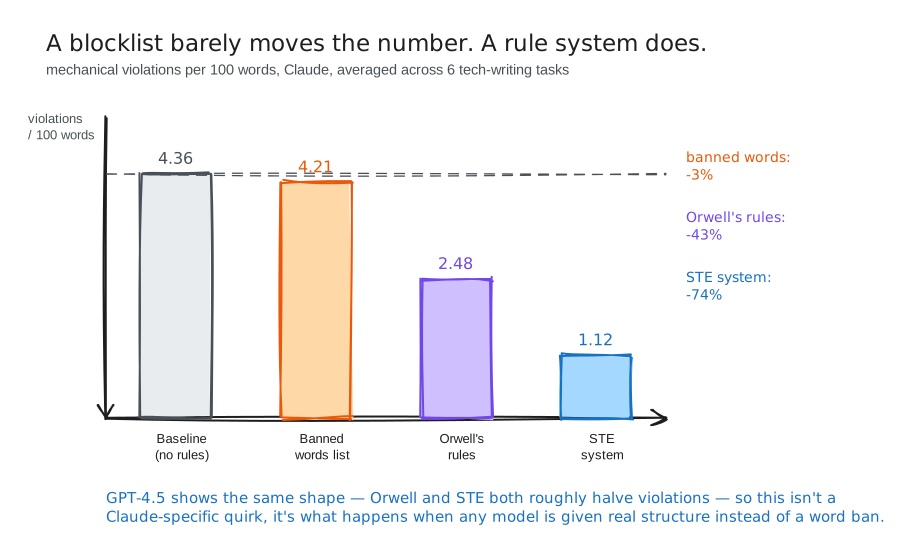 The blocklist condition removed em dashes and shifted the slop elsewhere — the total barely moved.
On Claude: baseline scored 4.36 violations per 100 words. A banned-words prompt brought that to 4.21 — a 3% improvement, essentially noise, confirming the whack-a-mole prediction. Giving the model George Orwell's six rules for writing (from "Politics and the English Language") cut it to 2.48, a 43% reduction. The STE-inspired system got it to 1.12, a 74% reduction. On GPT-4.5, both Orwell's rules and the STE system cut violations roughly in half, which matters because it means the effect isn't a Claude-specific artifact of how one model was trained — it's what happens generally when a model gets a structural writing system instead of a list of forbidden tokens.
Where this helps and where it doesn't
Two caveats are worth keeping, because they stop this from turning into a hammer for every writing problem:
Form isn't substance. STE fixes how a sentence is built. It cannot fix a response that has nothing to say — a beautifully constrained sentence with no real content is still an empty response, just a grammatically tidy one.
It's a register, not a universal style. STE-style writing is for technical documentation, PR descriptions, error messages, and API guides, places where one meaning per word is a feature. It's the wrong tool for creative writing or marketing copy, where the ambiguity, rhythm, and personality STE strips out are the actual point.
The bigger takeaway generalizes past this one standard: giving a model a structured system (Orwell's rules, an STE-inspired system, or presumably others in the same shape) produces measurable, repeatable improvement across different models. Banning individual words does not. If you're prompting an LLM for technical writing and you've been maintaining a blocklist, the data says you're optimizing the wrong lever — the fix is a rule system, not a longer list of forbidden words.