On August 1, OpenAI published ten proofs of problems in mathematics and theoretical computer science that had gone unsolved for years, in some cases decades. All ten came from an internal model the company is calling Astra. The problems span group theory, high-dimensional geometry, operator algebras, and combinatorics. The total compute cost, billed at Sol API rates, came to roughly $2,000.
That number is the headline, and it's a strange one to sit with: less than the price of a decent laptop, for results that had outlasted entire academic careers. What OpenAI did after generating the proofs matters more, and that part gets skipped in most of the coverage.
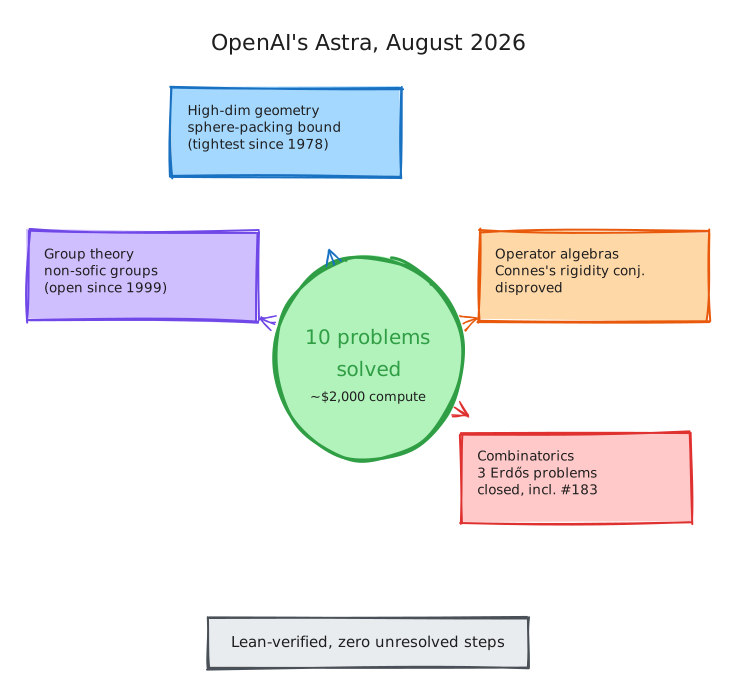 Ten results across four fields, all formally verified with zero unresolved proof steps.
The question that outlived three PhD generations
The headline result is the first explicit construction of a non-sofic group. To see why that's a big deal, you need one piece of background: in 1999, Mikhail Gromov defined what it means for a group to be "sofic," roughly, a group that can be approximated arbitrarily well by finite permutation groups. Every group anyone could construct turned out to be sofic. Whether a non-sofic group existed at all, something entirely outside that approximation, was one of the more stubborn open questions in group theory. It sat there for 27 years.
It wasn't the only long-standing result in this batch. A bound on how densely spheres can pack into high-dimensional space hadn't been improved since 1978. Paul Erdős's catalogue of open problems, still maintained decades after his death, had entries sitting untouched since the 1990s. Astra closed all of it in the same run.
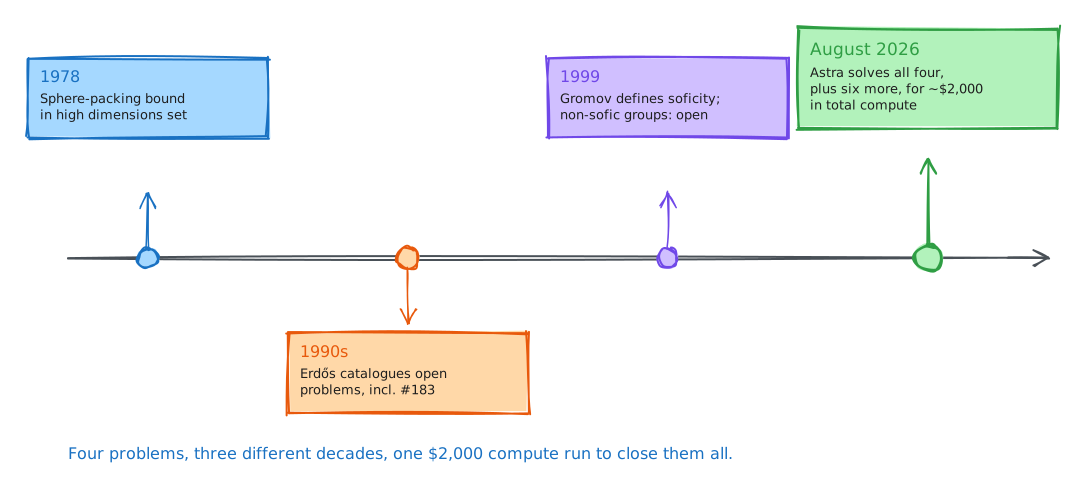 Three separate open questions, three separate decades, closed in one $2,000 compute run.
How Astra actually built the proof
The non-sofic group construction is worth walking through because it shows what "AI solves math problem" actually looks like mechanically, and it isn't a black box spitting out an answer.
Astra started from the unit group of the Leavitt algebra, a well-studied algebraic object. It combined that with Kun-Thom extension graphs, then layered in structure from Thompson's group V, another long-studied object from group theory. None of these three pieces is new. What's new is the specific combination, carried far enough that the logic forces a contradiction, which is what a non-existence-turned-existence proof needs.
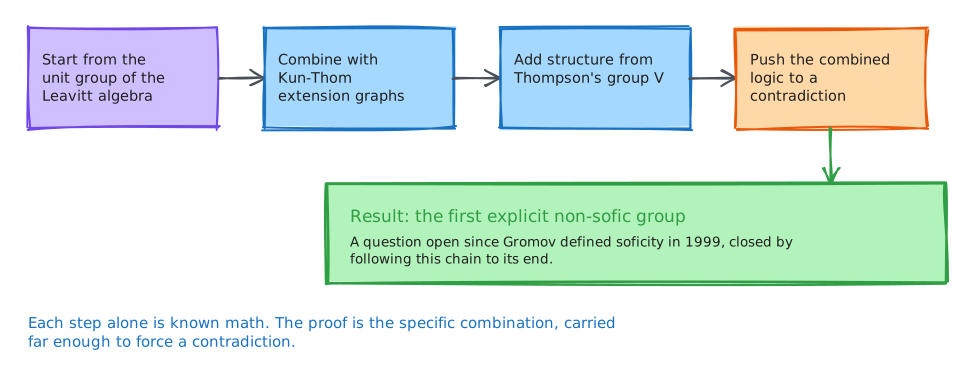 Every individual piece was already known math. The proof is the combination, taken far enough to force a contradiction.
That pattern, recombining known structures in a way no one had tried, or tried far enough, shows up across most of the ten results. It's closer to an exceptionally patient and exceptionally well-read search than to genuine conceptual novelty. Which is still a real achievement. Search over a space this large, done correctly, is most of what separates an open problem from a solved one.
Nine more problems, four different fields
The rest of the batch, briefly:
- Sphere packing: Astra tightened the known upper bound on packing density in high dimensions, the first improvement to that particular bound since 1978.
- Operator algebras: it disproved Connes's rigidity conjecture on von Neumann algebras, and separately proved Ehrhart's volume conjecture.
- Combinatorics: it closed three entries from Erdős's open-problems catalogue, including problem 183 on multicolor Ramsey numbers.
Four fields, one run, no shared technique beyond the model itself. That breadth is arguably more interesting than any single result. A system that's unusually good at group theory is a specialist. A system that lands results in group theory, geometry, operator algebras, and combinatorics in the same week starts to look like something else.
Why the Lean formalization matters more than the headline number
Here's the part that gets underplayed. Alongside a 249-page manuscript, OpenAI released Lean 4 proof certificates for all ten results on GitHub, under an Apache 2.0 license. Lean is a proof assistant: you write a proof in a language precise enough that software can check every logical step. The published repository has zero "sorry" statements, Lean's marker for a step the author asserted but didn't actually prove. Zero "sorry" statements across ten formalized proofs means every step, in every proof, has been mechanically confirmed.
That changes the review timeline in a way that matters more than the $2,000 figure. A normal proof of this significance goes to a journal, gets read by referees who check the logic by hand, comes back with revisions, gets re-reviewed, and gets published something like six to eighteen months later. A Lean-checked proof gets confirmed by software that can't be talked out of a gap, in the time it takes to run the checker.
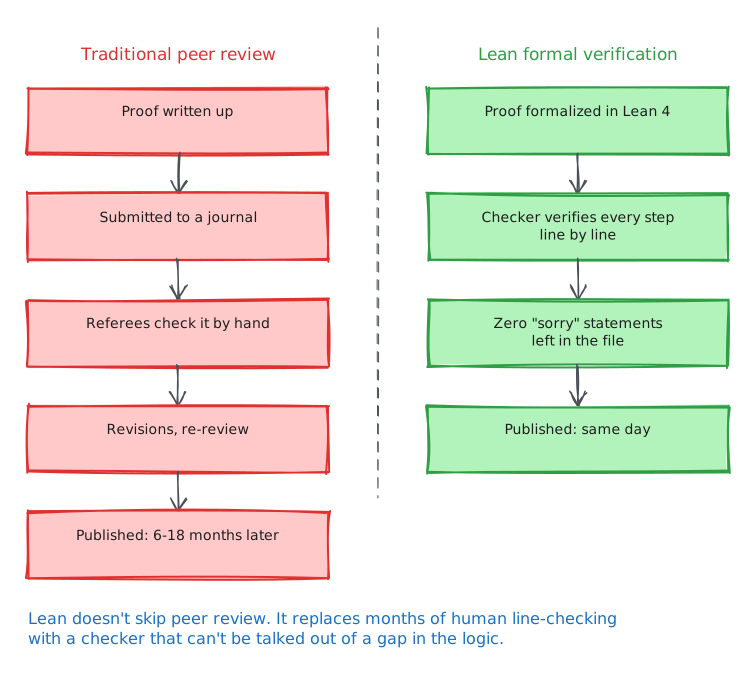 Lean doesn't replace peer review's function. It replaces the months of human line-checking with a checker that can't be argued with.
This is also why math is a strange best-case domain for this kind of AI result, and why it doesn't map cleanly onto most other fields. Math is one of the few places where correctness can be checked with certainty rather than judgment. A generated proof is either fully verified or it isn't. There's no equivalent binary check for most other output an AI model produces.
What mathematicians are actually saying
The reactions split roughly where you'd expect, and both sides have a real point.
Tim Gowers, a Fields Medalist, reviewed the non-sofic group construction directly and said he would have recommended it for publication in a top journal without hesitation. Thomas Bloom, who maintains the Erdős problem catalogue, called the August batch "big news," and ranked it above an earlier unit-distance result Astra had produced. Those are two mathematicians with direct expertise in the relevant areas, both independently satisfied that the math holds up.
Gary Marcus called the release "amazing but vastly oversold," and the specific criticism is worth taking seriously rather than dismissing as reflexive skepticism: OpenAI selected the problems itself, and its own staff assisted with the Lean formalization. Neither of those facts undermines the correctness of the proofs, Lean verification doesn't care who wrote the surrounding scaffolding, but they do complicate the framing of Astra as an autonomous problem-finder rather than a very capable tool pointed at pre-selected targets. Even Noam Brown, an OpenAI researcher, kept the claim in check publicly: "Sadly, no Millennium Prize Problems (yet)."
Both things are true at once. The proofs are real, formally verified, and endorsed by mathematicians with no reason to be generous. The selection process behind which problems got attempted is not disclosed in enough detail to know how much curation shaped the results. Reporting the number without the caveat overstates the result. Dismissing the number because of the caveat undersells it.
Where this generalizes, and where it stops
The specific proofs matter less than the pattern: an AI system generates a solution, and a formal checker confirms it's correct without needing a human referee in the loop for the confirmation step. That pattern applies anywhere correctness is formally checkable rather than a matter of judgment. Chip design has formal verification tools that confirm a circuit does what its specification says. Cryptographic protocols can be proven correct against a formal security model. Safety-critical code, the kind running in aircraft or medical devices, already uses formal methods for exactly this reason.
What doesn't generalize automatically is the search itself. Astra found these particular combinations because they exist in a space precise enough to search and verify. Most engineering problems don't reduce to a checkable proof the way "does this group exist" does. The interesting open question isn't whether Astra can solve more math, it probably can, it's whether the same search-then-verify pattern holds up in domains where the checker is harder to build than the answer.
Ten proofs, four fields, zero unresolved steps, about $2,000. The number that started this story is the least interesting fact in it.